
November is COPD Awareness Month in the United States — a month dedicated to one of the most common chronic respiratory conditions worldwide (American Lung Association). For distributors, pharmacies and care providers, it is also the busiest planning window of the year for home oxygen equipment.
This guide covers what actually differs between concentrator classes, the features worth specifying, and the documentation to check before you commit to a container.
Start with the prescription, not the catalogue
A home oxygen concentrator delivers concentrated oxygen by drawing in room air and separating nitrogen out using molecular sieve technology. The unit does not decide the therapy — the prescription does.
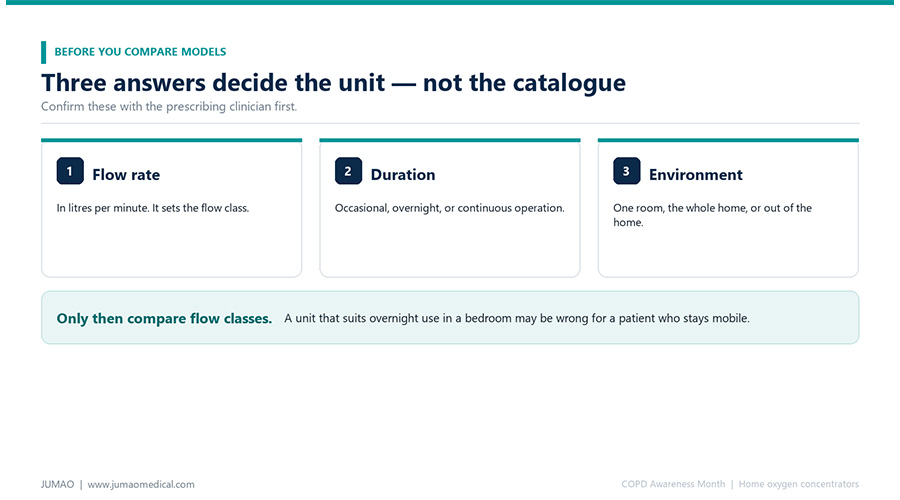
Before comparing models, confirm three things with the prescribing clinician:
Flow rate required (in litres per minute).
Duration — occasional use, overnight use, or continuous operation.
Environment — one fixed room, the whole home, or out of the home during the day.
Then match those three answers to a unit. A model that is excellent for overnight use in a bedroom may be the wrong choice for someone who needs to remain mobile.
3 L, 5 L and 10 L: what the numbers actually mean
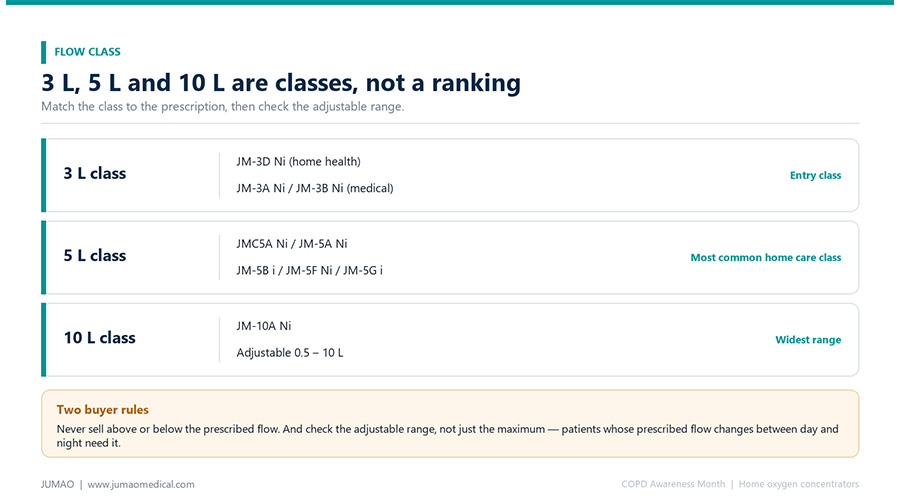
Concentrators are usually classified by their flow class. Our range covers three: 3 L, 5 L and 10 L classes.
3 L class — includes the JM-3D Ni (home health) and the JM-3A Ni / JM-3B Ni (medical).
5 L class — includes the JMC5A Ni, JM-5A Ni, JM-5B i, JM-5F Ni and JM-5G i. This is the most common home care class.
10 L class — the JM-10A Ni, adjustable from 0.5 to 10 L.
Two practical rules for buyers:
Never sell above or below the prescribed flow. A 5 L unit set at 5 L is not equivalent to a 10 L unit set at 5 L in every clinical scenario — the prescribing decision belongs to the clinician.
Check the adjustable range, not just the maximum. The JM-10A Ni spans 0.5–10 L, which matters for patients whose prescribed flow changes between day and night.
Continuous operation and ventilator compatibility
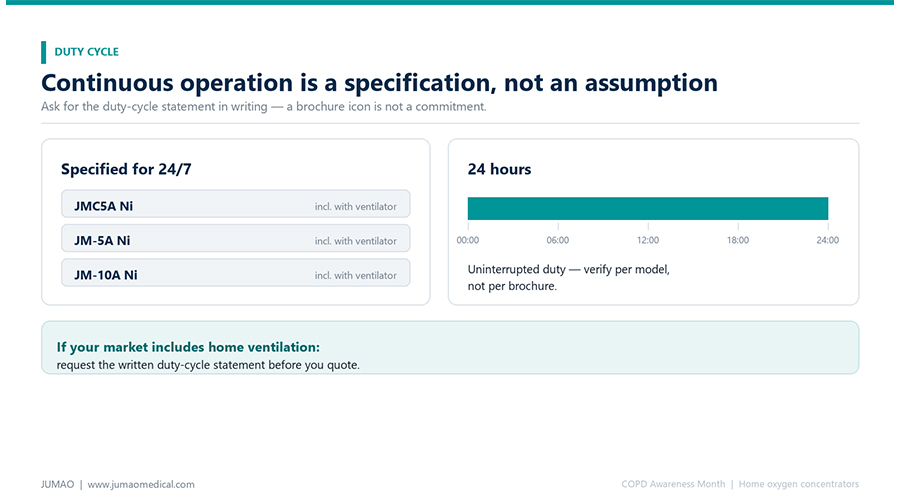
For patients on long-term oxygen therapy, the question of whether a concentrator can run without pause is central. The JMC5A Ni, JM-5A Ni and JM-10A Ni are designed for 24/7 continuous operation, including 24/7 working with a ventilator — a specification worth checking explicitly, because not every unit on the market is built for uninterrupted duty cycles.
If your market includes home ventilation, ask the manufacturer for the duty-cycle statement in writing rather than relying on a brochure icon.
Portability: AC, DC and battery
Stationary and portable concentrators solve different problems. The JM-P50A portable oxygen concentrator is designed for 24/7 use at home or on the go, and runs on AC power, DC power (for example, from a vehicle) or a rechargeable battery, with 1–6 flow settings and a maximum output of 1470 ml/min. It includes a 2.8-inch colour LCD and visual/audible alarms, and ships with a carry bag.
For a distributor, the relevant considerations are battery runtime under your market’s typical usage, whether the unit is supplied with the plug type your region requires, and whether spare batteries and carry accessories are available as separate line items.
The refill system: oxygen away from the concentrator
A concentrator only helps where there is power. For outdoor use, some suppliers offer a refill station configuration: the JMF 200A oxygen filling machine compresses medical oxygen produced by a concentrator to a higher pressure and fills it into cylinders — either 1 L (JMG-1.0A) or 2 L (JMG-2.0A). Each cylinder’s integrated valve reduces the pressure to a safe level for the user and adjusts the outlet flow, so the patient can take oxygen outdoors without carrying the concentrator.
This configuration is usually quoted as a system rather than a single SKU, and it is worth clarifying with your supplier whether a concentrator is included or matched separately.
Safety features to require, not hope for
Concentration is a mechanical process, and the user is often a patient living alone. Specify these features in writing:
Real-time oxygen purity monitoring via O₂ sensor (our units operate at 93% ±3%).
Alarm functions — low flow, low purity, power failure, high/low pressure, heat protection.
Pressure safety valve for over-pressure protection.
Accessible indicators — visible and audible alarms, not buried in a menu.
Ask your supplier to show you their pre-shipment test record for these functions. Ours are tested before dispatch with alarm and purity verification.
The documentation set for importers
Home oxygen equipment is regulated differently in every market, and approval scope is model-specific. As a reference for how narrow that scope can be, our own concentrator documents are:
Japan — PSE certificate for the JM-5A Ni and JM-3A Ni, per J60335-1 (2024) / J55014 (H27), plus Japan EMC test report
EMC testing — IEC 60601-1-2 report and IEC TR 60601-4-2 report for the portable JM-P50A.
Aviation environment — RTCA/DO-160G Category M EMC test report for the JM-P50A, relevant when end users travel by air.
Quality system — ISO 9001:2015 covering medical molecular sieve oxygen concentrators; ISO 14001:2015.
Export — export sales certificate for medical molecular sieve oxygen concentrators issued by the Jiangsu Medical Products Administration.
What to plan for now (distributor checklist)
The Q4 respiratory season concentrates demand into a few weeks. In our own planning we would advise:
- Fix your model mix early. 5 L class units carry the bulk of home care demand; 10 L units serve higher-flow prescriptions.
- Order accessories on the same container. Filters, humidifier bottles, cannulas and carry bags are low-cost, high-repeat items — and their absence is what generates after-sale friction.
- Do the container math. Reference: the JM-5A Ni concentrator carton measures 42 × 35 × 65 cm, net/gross weight 16/18.5 kg — model-specific packing data determines your real landed cost.
- Confirm supply capacity at both sites. Our China plant has annual capacity for 1,000,000 oxygen concentrators, and our Thailand plant adds capacity for 200,000 concentrators per year — worth asking any supplier for the equivalent statement.
- Align marketing with caregiver season. November is also National Family Caregivers Month, and caregiver-facing education drives qualified interest better than product specs alone.
Post time: Oct-23-2026