
Demand for home-based care keeps rising. The workforce delivering it is not keeping up — and that changes what equipment has to do.
Jiangsu Jumao X-Care Medical Equipment Co., Ltd (JUMAO), a manufacturer of rehabilitation and home care equipment, today published an industry note on a constraint that is reshaping how home care equipment is specified: the shortage of trained care workers, and the rising share of care delivered by family members rather than professionals.
The demand side is already settled
The direction of travel has been documented for years. WHO projects that by 2030, one in six people worldwide will be aged 60 years or over, and estimates that 2.5 billion people already need one or more assistive products — a number it expects to exceed 3.5 billion by 2050.
Anyone planning a care equipment range for the next decade is working with a demand curve, not a fashion.
The workforce side is where the numbers turn
WHO now puts the projected shortfall of health workers at around 11 million by 2030, revised upward from its earlier estimate of 10 million, even as the global stock of health workers passes 70 million. Europe narrows the picture further. Eurocarers, citing analysis by the European Commission and the OECD, notes that over one third of doctors and a quarter of nurses in Europe are aged over 55 and due to retire in the coming years; an earlier estimate put the EU-27′s need for newly trained or recruited health and long-term care workers between 2018 and 2030 at 10.9 million. In the United States, PHI’s Key Facts 2025 report projects more than 6.1 million total job openings in the home care workforce between 2024 and 2034, including over 681,000 newly created jobs. Job openings, not headcount, is the operative phrase. A workforce that continues to exist mainly because of turnover is also a workforce that is perpetually new to the job.
So who is actually operating the equipment?
In most European countries, long-term care is not primarily delivered in institutions. Eurocarers reports that around 80% of care in Europe is provided by informal carers, and the European Parliament estimates that roughly one in six EU citizens is an informal carer.
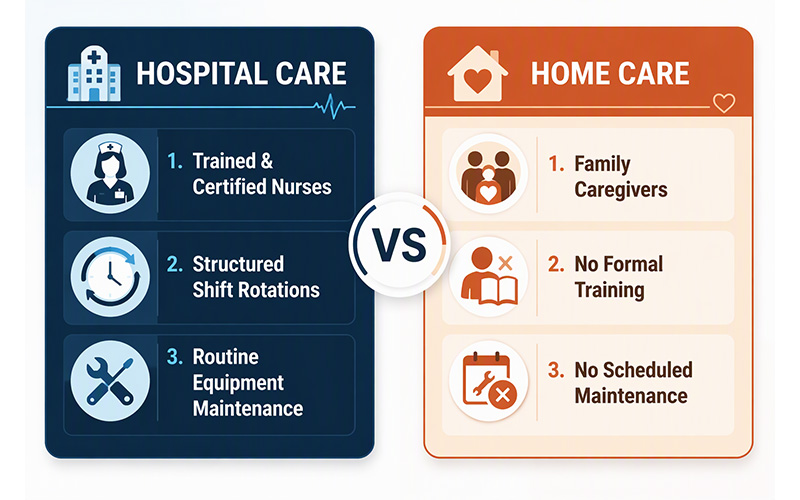
The typical operator of a home care device is therefore not a trained nurse mid-shift. It is a spouse, a daughter or a son — often older themselves — learning the device in a living room the day it is delivered, and using it without anyone watching. That single change reframes the specification question. A device that performs well when set up by a technician and monitored by clinicians can behave very
differently when it is unpacked by one untrained person, used daily, cleaned, stored in a hallway cupboard and moved between rooms.
Five things this puts back on the specification sheet
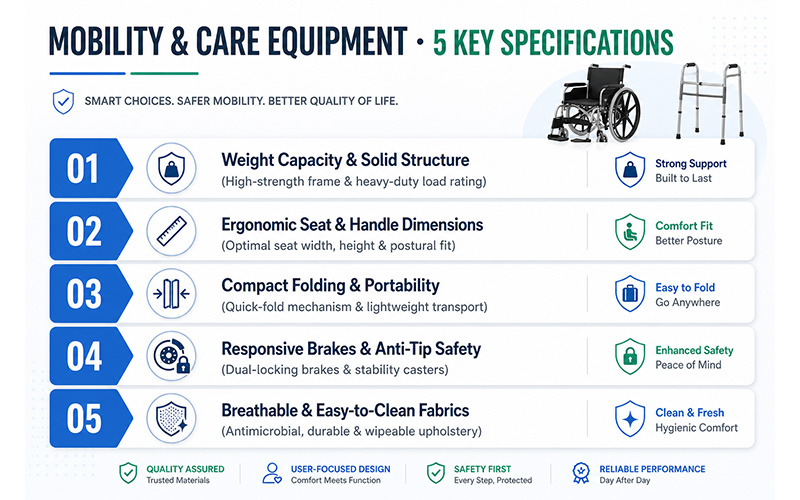
1. Setup that does not need a technician. If commissioning requires a service visit, that visit is now part of the product cost — and part of the delay.
2. One-person handling. Unboxing weight, folding and unfolding steps, and how the device is lifted into a car boot matter more than they did when porters existed at both ends of the journey.
3. Noise in a shared home. In a care home, background noise is expected. In a one-bedroom flat shared with a spouse, it is a daily tolerance test — and one of the first reasons a device gets switched off early.
4. Controls that assume nothing. Interfaces designed for staff who are trained once and use the device every day are not the same as interfaces for someone who uses it occasionally and did not attend the training.
5. Serviceability rather than replacement. Tyres, castors, brake components and battery packs should be identifiable parts with a stated replacement interval, not a reason to write off the equipment.
Where JUMAO stands
JUMAO supplies rehabilitation and home care equipment to distributors, care institutions and retail partners, and treats the buying decision as a specification conversation rather than a price list: the intended user, the space it will live in, how it will be moved, and what happens the first time it needs a part.
About Jiangsu Jumao X-Care Medical Equipment Co., Ltd
Jiangsu Jumao X-Care Medical Equipment Co., Ltd (JUMAO) is a manufacturer of rehabilitation and home care medical equipment, including oxygen concentrators, manual and electric wheelchairs, rollators and walking aids, walking canes, adjustable nursing beds and related care products. The company serves distributors, care institutions and retail partners worldwide with export-ready solutions and flexible OEM/ODM support. For more information, visit www.jumaomedical.com.
Post time: Oct-09-2026