
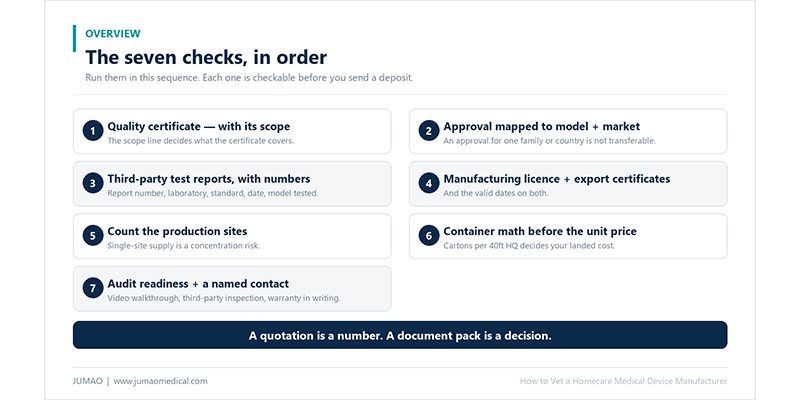
Sourcing homecare equipment — oxygen concentrators, wheelchairs, electric beds — usually starts with a request for quotation. But a price tells you very little about whether your shipment will clear your market’s requirements, or whether the second container will arrive on schedule.
1. Read the quality certificate’s scope, not just its logo
Every manufacturer claims a quality system. The useful question is: what does the certificate actually cover?
An ISO 9001:2015 certificate must state its scope of registration. As an example, our certificate (no. 00225Q20623R2M, issued by China Quality Mark Certification Group) covers the design and production of manual wheelchairs and medical molecular sieve oxygen concentrators — and nothing beyond that. If the certificate scope does not name the product category you are buying, that certificate does not cover your purchase.
Two practical steps:
- Copy the certificate number and verify it on the issuing body’s public database.
- Check the validity dates against your planned order and delivery window.
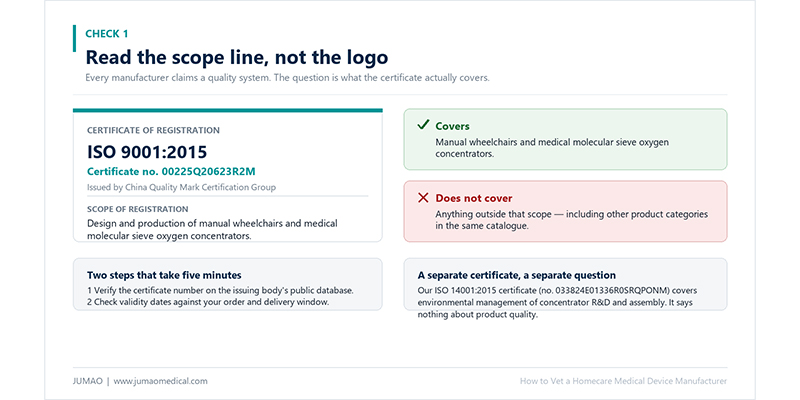
Ask separately about environmental management (our ISO 14001:2015 certificate, covers R&D, assembly and processing of medical molecular sieve oxygen concentrators). It says nothing about product quality, but it does indicate a managed facility rather than an improvised workshop.
2. Map every approval to a product and a market
Suppliers often present a wall of certificates. Reduce it to one question: which document covers this exact model, in my market?
Medical device approvals are product-specific and market-specific. Using our own portfolio as an example of that structure:
- EU — Under Regulation (EU) 2017/745 (MDR), our power wheelchairs (JMPW series), manual wheelchairs (JMWC series) and lightweight rollators (JMLS series) are registered as Class I devices through our EU Authorized Representative Humiss Beratung GmbH, covered by our Certificate of EU Medical Device Notification . Our power wheelchair series also holds an EU Declaration of Conformity (Basic UDI-DI 697285553PW6C).
- UK — Our manual wheelchairs are registered with the UK MHRA (GMDN 37687) through a UK Responsible Person.
- Japan — PSE certification applies to specific concentrator models only (JM-5A Ni and JM-3A Ni).
The pattern is what matters: a certificate for one product family does not transfer to another, and an approval for one country does not open another. Ask for the certificate that names your model and your destination market.
3. Ask for third-party test reports, with numbers
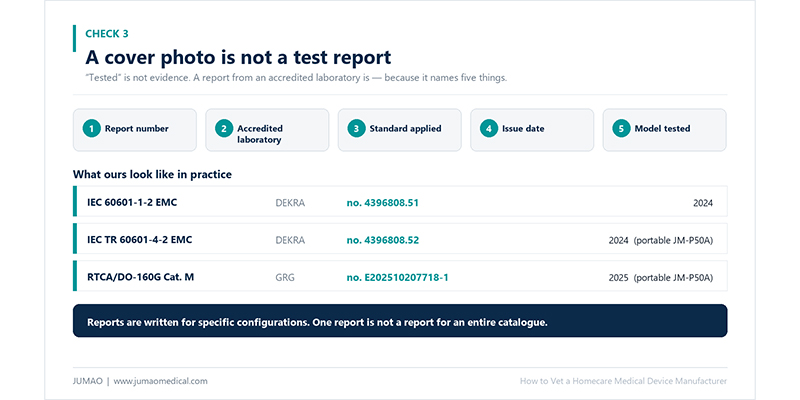
“Tested” is not evidence. A report from an accredited laboratory is, because it names the standard, the laboratory, the date and the tested model. Ask for the report number, not a screenshot of a cover page.
For our concentrators, for example, third-party EMC testing includes IEC 60601-1-2 report no. 4396808.51 (DEKRA, 2024) and IEC TR 60601-4-2 report no. 4396808.52 for the portable JM-P50A. The portable concentrator also holds an RTCA/DO-160G Category M EMC test report — relevant if your end users travel by air, or if a distributor asks how the unit behaves in an aviation electromagnetic environment.
4. Verify the manufacturing licence and export documentation
Medical device manufacturing licence — evidence the facility is licensed for production of the device class in question.
Export sales certificate issued by the provincial Medical Products Administration — frequently requested at customs and in registration dossiers. Our current certificates (issued 2026-03-11) cover electric wheelchairs, manual wheelchairs and medical molecular sieve oxygen concentrators.
Check the dates. An expired certificate discovered at the port is a delay you cannot invoice back to anyone. If your product contains a lithium-ion battery pack, also request the MSDS — because freight forwarders will ask for it before accepting the booking.
5. Count the production sites, not just the address
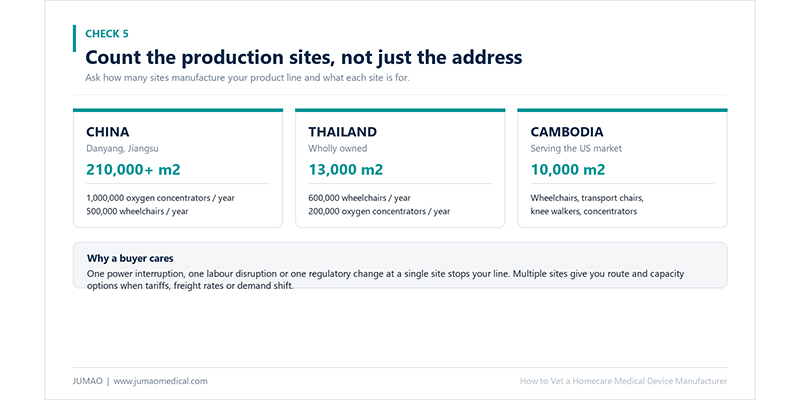
Single-site supply is a concentration risk: one power interruption, one labour disruption, one regulatory change at that location and your line stops. Ask how many sites manufacture your product line and what each site is for.
Our own structure, as a reference point: China headquarters in Danyang, Jiangsu (over 210,000 m², annual capacity 1,000,000 oxygen concentrators and 500,000 wheelchairs); a wholly-owned Thailand plant of 13,000 m² that completed construction in June 2025 with capacity for 600,000 wheelchairs and 200,000 concentrators per year; and a 10,000 m² Cambodia facility producing for the US market. Three sites give a buyer route and capacity options when tariffs, freight rates or demand shift.
6. Do the container math before you negotiate the unit price
Annual capacity is a marketing number. Container loading is an operating number. Ask for carton dimensions, net/gross weight and 40ft HQ loading quantity per model, then calculate your real landed cost per unit.
Then ask the operational question: can the factory reserve a production slot for you in your peak season, and what does the schedule look like?
7. Test audit readiness and ask for a named contact
Three requests separate an organised manufacturer from a responsive sales inbox:
1.A short video walkthrough of the line that will produce your model.
2.Willingness to host third-party inspection (SGS, BV or your own agent) before shipment.
Our concentration lines run alarm and safety function testing before shipment, including oxygen purity monitoring via O₂ sensor, pressure safety valve checks and alarm verification (low flow, low purity, power failure, high/low pressure, heat protection). Ask your supplier what their pre-shipment test list contains, and ask to see a filled-in report.
Post time: Oct-16-2026