
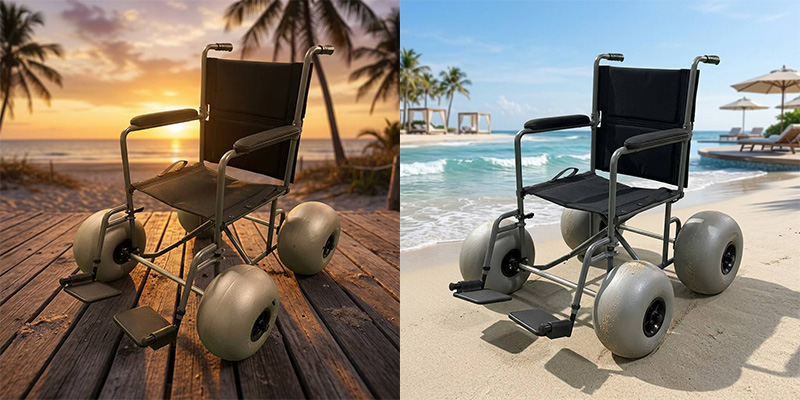
Beaches may be challenging to navigate for people who use wheelchair, particularly when it comes to traversing sandy areas and gaining access to the water. Beach wheelchair is s special type of wheelchair specifically designed for soft, uneven surfaces such as sand, helping people with mobility issues enjoy sandy beaches. Jumao beach specific wheelchair is manually operated, its wide wheels allow for easy movement on the sandy beach surfaces, giving you an experience that would otherwise have been impossible with a standard wheelchair.
Key Features and Types
- Beach-Specific Model: The most notable feature is its wide inflatable tires (similar to those on sand vehicles), which prevent sinking into the sand. Made primarily of waterproof, rust-resistant aluminum alloy or plastic for easy rinsing. Some basic models even lack foot pedals, making them lighter and more portable.
- All-terrain/water-crossing type: Suitable not only for sand but also for snow and grass, and typically can be directly pushed into seawater.
- Power type: Manual models are lightweight and inexpensive, but require someone else to push them (which is very tiring in deep sand); electric models offer self-propulsion, but are heavier and more expensive, requiring attention to battery waterproofing.
The structure of the beach-specific manual wheelchair is designed specifically to facilitate smooth movement on the soft sand surface. It is quite different from ordinary wheelchairs. Its main structural components and features are as follows:
- Frame and Material: This is the most fundamental part. To ensure durability in sandy environments, the frame is mostly made of steel or aluminum. Aluminum is lighter( the overall weight of the chair is approximatelt between 13-22kg), while steel structures are more sturdy and can generally support a load of 100kg.
- Wheel system: This is the most fundamental difference between beach wheelchairs and ordinary wheelchairs.
- Wide inflate tires: To increase the contact area and reduce sinking, both the front and rear wheels are equipped with wide low-pressure inflatable tires, which are also commonly referred to as “balloon tires”.
- Rear wheel design: Most of the rear wheels are detachable, facilitating transportation and storage. Some medels have extremely large rear wheels(such as 24 inches) and have hand-wheel rings installed on the wheel rims for easier pushing.
- Seat back system: To ensure comfort during long periods of sitting, the seat cushion and backrest are usually made of soft materials, such as Oxford nylon fabric with built-in foam. The seat cushion and backrest are also often designed to be detachable, making cleaning and replacement easier.
- Armrests and footrests: To facilitate the user’s exit from the vehicle from the side, the armrests are usually designed to be foldable backward or detachable. The footrests are generally height-adjustable, and some models of the footrests can rotate inward or outward, making it convenient for the user to get in and out or adjust their posture.
After entering the water, be sure to thoroughly rinse the axle and frame with fresh water to prevent corrosion from salt. For electric models, strictly follow the waterproofing level restrictions and do not leave the motor submerged in water for an extended period.
Going to the beach shouldn’t be impossible because of a disability. Often, it’s only a matter of making a few adjustments. JUMAO beach wheelchairs help you to get to the sandy areas, and you can forget about your beach access challenges for good!
Post time: Jul-09-2026