
Most distributors do not lose money on the wrong brand. They lose it on the wrong mix — a container full of 10L units when their market only reimburses 5L, or a pallet of pulse-dose portables sold to patients who need continuous flow. This guide is written for the buyer who has to commit to a specification, a certification path and a delivery window before the season starts. It covers the five decisions that actually determine whether an oxygen concentrator line sells through: model mix, spec sheet numbers, flow mode, market certification, and landed cost over five years.
1. What distributors actually buy: 5L home, 10L clinical, POC travel
Three product families carry almost every oxygen concentrator catalogue, and they are not interchangeable.
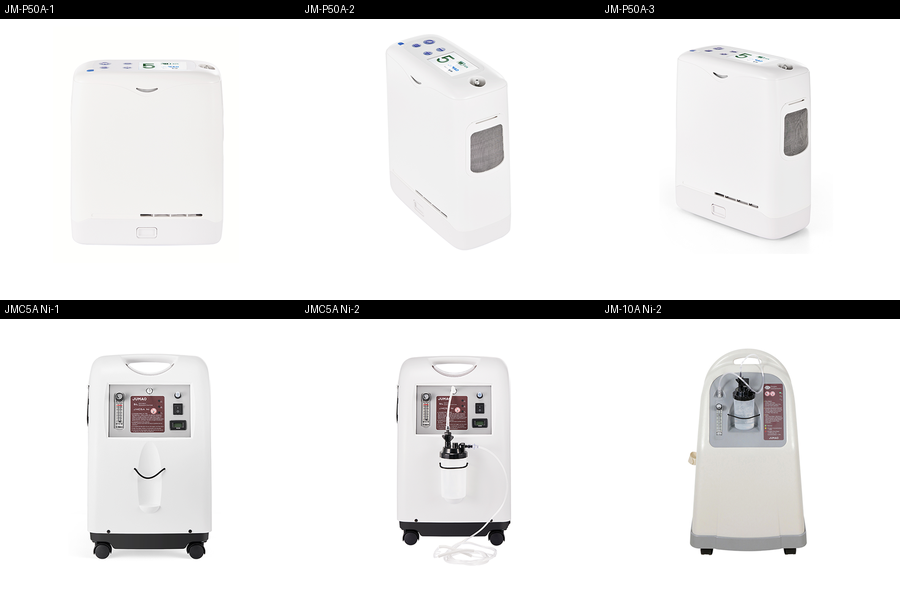
5L home concentrators are the volume business. One to five litres per minute, continuous flow, designed for stationary use in a bedroom or living room. They are what home-care providers deploy at scale, what rental fleets are built on, and what most reimbursement codes were written around. If you are building a first order, this is the category that pays for the container.
10L clinical concentrators serve a different patient and a different buyer. Higher flow supports clinical and institutional settings, long-term care facilities, and patients requiring higher liter flow under prescription. The unit economics are harder — fewer units per pallet, higher unit value, longer sales cycle — but the margin per unit and the account quality are usually better. Review our 10L clinical oxygen concentrators if your customer base includes facilities rather than only households.
Portable oxygen concentrators (POC) are the ambulatory category: battery-powered, carry-on sized, sold to patients who leave the house. They command the highest unit price and generate the most after-sales contact, because batteries age, filters clog and users travel. Browse the portable oxygen concentrators range if ambulatory demand is part of your market.
The practical rule most experienced buyers apply: build the base order on the category that already has reimbursement or rental infrastructure in your market, then add the adjacent category once your service capability is in place. Selling a POC fleet without battery service capability is how distributors end up with returned units and a damaged account.
2. The five numbers that decide a spec sheet: flow, purity, noise, sieve life, service interval
Two suppliers can send you visually identical brochures and still be selling very different machines. Five numbers separate them, and each one has a follow-up question attached.
Flow rate (LPM). The headline number, and the least meaningful on its own. Ask at what purity the flow is rated. A unit that delivers 5 LPM at a lower oxygen concentration is not the same product as one that holds concentration at 5 LPM across the full range. Confirm the flow-purity pair, not the flow figure alone.
Oxygen purity. Usually expressed as a percentage with a tolerance band, measured under defined conditions. Ask for the test standard, the measurement point (outlet vs. patient end of tubing) and whether the figure holds at maximum flow. Purity that only holds at 1 LPM is a marketing number.
Noise. Always quoted in dB(A), and always meaningless without a distance and a load condition. Ask: measured at what distance, at which flow setting, in what enclosure. A quiet number at minimum flow tells you nothing about a bedroom at 3 LPM overnight.
Sieve life. Zeolite sieve is the consumable that determines the long-run service cost of the machine. Ask whether the quoted life is in hours or years, and under what duty cycle. This is the single number that most changes a five-year cost model.
Service interval. How often the unit needs filter replacement, sieve inspection and performance verification. A unit with a long service interval and a documented procedure is worth more to a distributor than a cheaper unit that requires monthly attention — because your service labour, not the factory’s, absorbs the difference.
Ask every supplier to send these five values in writing, with the test conditions attached. If the answer is a brochure, you have your answer about the supplier.
3. Continuous flow vs pulse dose: who needs which
This is the specification decision that generates the most returns, because it is usually made on price rather than on patient profile.
Continuous flow delivers oxygen on every breath, at a constant rate, whether the patient inhales or not. It is the mode that supports sleeping patients, mouth breathers, and anyone whose breathing pattern is shallow or irregular. It is also the mode that draws more power and needs a larger battery or mains supply.
Pulse dose (demand flow) releases a bolus of oxygen when it detects an inhalation. It is efficient, it extends battery runtime substantially, and it is what makes a small carry-on POC viable for travel. It also depends on a trigger — and triggers can miss.
The buying rule is straightforward. If your customer serves overnight or clinical use, continuous flow is the default. If your customer serves active, ambulatory patients who are otherwise stable, pulse dose is appropriate and the runtime advantage is real. If you serve both, stock both and train your intake team to ask the question, because the customer will not volunteer it.
A word on hospital and airline use: pulse-dose devices are commonly accepted for in-flight use only where the specific model is approved by the carrier and the battery capacity meets the airline’s declared limit. Never promise in-flight suitability on the basis of the device category. Point customers to the battery and shipping documentation in our import documentation checklist, and let them verify with the carrier.
4. Certification by market: US, EU, LatAm, Middle East
Certification is not a marketing badge. It is the gate that decides whether your container clears customs and whether your customer can legally resell.
United States. Oxygen concentrators are medical devices. The regulatory pathway typically involves a 510(k) premarket submission with a cleared predicate, an establishment registration, and a device listing. Importers should hold the clearance documentation, the labelling, and the quality system evidence before the first shipment. As a manufacturer we provide documentation on request and we do not publish clearance claims that a buyer cannot verify against the public database.
European Union. Under MDR 2017/745, a Class IIa device requires a Notified Body certificate, a Declaration of Conformity, and EUDAMED registration. The buyer’s own Economic Operator obligations — importer name on the label, retention of the DoC, vigilance reporting route — sit with you, not with the factory.
Latin America and the Middle East. Registration is country-specific: ANVISA in Brazil, COFEPRIS in Mexico, SFDA in Saudi Arabia, and equivalent authorities elsewhere in the Gulf. Timelines vary from weeks to many months depending on whether a local registration holder is required. Plan registration before you plan the purchase order.
Our import documentation checklist lists the document set by market. Use it as the request list when you open a supplier conversation — the response speed tells you as much as the documents themselves.
5. MOQ, lead time and OEM/ODM options
Three commercial terms decide whether a supplier can actually serve you, and all three should be in writing before a sample is booked.
MOQ. Minimum order quantity is usually set per model and per packaging configuration, not per catalogue. Ask for the MOQ at the model level, then ask what changes it: mixed-model containers, private label cartons, or a first trial order. A supplier that will only quote one number for the whole catalogue has not thought about your inventory risk.
Lead time. Ask for the production lead time and the shipping lead time separately, and ask what the lead time is measured from — purchase order, deposit, or artwork approval. The most common cause of a missed season is a lead time quoted from the wrong starting point.
OEM/ODM. If you intend to sell under your own brand, clarify the scope early: logo and carton only, or housing, colourway, control panel and manual localisation. Each step changes tooling cost, MOQ, certification responsibility and lead time. Certification is the part buyers underestimate — a private-label unit still needs its own labelling and, in some markets, its own registration linkage.
If your volume plan is still forming, ask for the current MOQ and lead-time sheet rather than working from an older quotation.
6. Total cost of ownership: filters, sieve, compressor, spare parts
The purchase price is the smallest part of a five-year oxygen concentrator cost model, and it is the only part most buyers compare.
Build the model on four lines.
Filters. Consumable, cheap per unit, and the first thing that fails when a user skips maintenance. Budget by units in service, not units sold.
Sieve. The dominant long-run cost. Sieve life, replacement procedure and whether the sieve is field-replaceable or factory-service-only determines whether your service network can handle it locally.
Compressor. The wear item that decides the economic life of the machine. Ask for the compressor service interval and the replacement part availability window — a unit whose compressor is unavailable in year four is a write-off, not an asset.
Spare parts. Ask for the parts list, the part numbers and the stocking recommendation at the time of the first order. Distributors who wait until the first failure to ask for a parts list usually wait weeks for the part.
Add your own service labour and inbound freight to those four lines and the ranking often inverts: the cheapest unit at purchase is frequently the most expensive at year three.
Post time: Nov-05-2026