
Part1:Basic Principles of Oxygen Concentrator
If you or your famility has been prescribed supplemental oxygen therapy, one of the first decisions you’ll face is choosing between a portable oxygen concentrator (POC) and a stationary home concentrator. Both devices serve the same fundamental purpose-delivering concentrated oxygen from ambient air—but they differ significantly in design, performance, and ideal use scenarios.
To help you make a choice, we will compare our two products:
JM-5A Ni-a stationary 5L/min continuous-flow concentrator
JM-P50A-a lightweight, pulse-dose portable concentrator
Both Portable and Stationary Concentrator operate on the same principle: Inhale indoor air, remove nitrogen, and deliver concentratied oxygen to the user through a nasal cannula or mask. Unlike oxygen tasks or liquid oxygen systems, oxygen concentrator don’t reply on stored oxygen. They generate it on demand from the surrounding air, eliminating the need for refills.
Part2: The Critical Difference between Continuous Flow and Pulse Dose
Continuous flow delivers oxygen at a constant rate, measured in liters per minute (L/min), regardless of whether you are inhaling or exhaling. This is the traditional method used in hospitals and by most stationary home concentrators.
Pulse dose delivers oxygen only during inhalation. The device senses when you begin to breathe in and releases a short burst, or “bolus,” of oxygen, then remains inactive while you exhale.
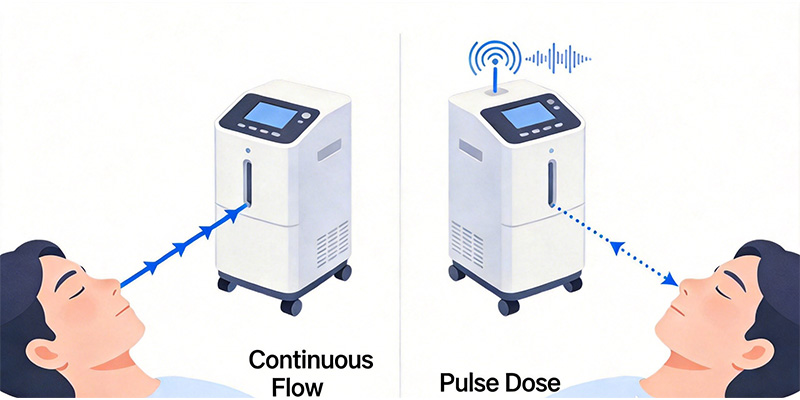
| Feature | Continuous Flow | Pulse Dose |
| How it works | Constant oxygen stream | Oxygen bursts during inhalation only |
| Efficiency | Lower(oxygen lost during exhalation) | Higher(oxygen conserved) |
| Typical device | Stationary concentrators(JM-5A Ni) | Portable concentrator(JM-P50A) |
| Performance at high respiratory rates | Consistently reliable | May decline with rapid breathing |
| Power consumption | Higher(needs mains power) | Lower(battery-compatible) |
Parts: Stationary Concentrators-Designed for Home
| Parameter | Value |
| Model | JM-5A Ni |
| Flow Range | 0.5-5L/min(continuous) |
| Oxygen Purity | 93%±3% |
| Outlet Pressure | 38±5 Kpa |
| Noise Level | ≤42dB(A) |
| Net/Gross Weight | 16/18.5kg |
| Machine Size(cm) | 33X26X54 |
| Carton Size(cm) | 42X35X65 |
| Power(VA) | 390/450 |
| Operation | 24 hours non-stop |
JM-5A Ni-Main safety and monitoring functions
- Integrated control panel with LCD – real‑time oxygen concentration display
- Elapsed time meter
- Pressure safety valve
- Power loss alarm
- High‑and‑low‑pressure alarm
- Low oxygen concentration alarm
- Low oxygen flow alarm
- Heat protection (compressor & concentrator safety)
- Complete plastic outer shell with circuit breaker
Optional accessories: Oxygen mask / Reusable nebulizer (8 ml capacity)
The advantages of stationary oxygen concentrators
- Reliable oxygen delivery – maintains 93%±3% oxygen concentration across all flow settings
- Higher flow capacity – up to 5 L/min continuous flow, essential for patients with higher oxygen demands
- Proven performance – stationary concentrators consistently outperform POCs, especially at rest and during sleep
- Ideal for nighttime use – continuous flow ensures prescribed oxygen regardless of breathing pattern changes
Precautions
- Not portable – requires mains electricity and is too heavy (16 kg) to transport regularly
- Produces a continuous hum (≤42 dB), which is quiet but may require placement away from the bedside
Best suited for: Patients who need oxygen primarily at home, especially those with higher flow requirements (>3 L/min continuous) or those who use oxygen during sleep.
Part4: Portable Oxygen Concentrators(POCs)-Freedom to Move
JM-P50A Specifications
| Parameter | Single Battery(8 cells) | Double Battery(16 cells) |
| Oxygen Concentration | ≥90% | ≥90% |
| Oxygen Delivery Setting | 1 – 6 (pulse dose) | 1 – 6 (pulse dose) |
| Max. Output (ml/min) | 1260 | 1260 |
| Power (VA) | 90 | 90 |
| Noise dB(A) | ≤42 at setting 2 | ≤42 at setting 2 |
| N.W (Kg) | 2.16 | 2.56 |
| Size (cm) | 18.5 × 8.8 × 21 | 18.5 × 8.8 × 23.8 |
| Battery Run Time | 5 hours @ setting 2 | 10 hours @ setting 2 |
| Charge Time | 3 hours | 6 hours |
User interface and alarm function
- Easy interface, 2.8‑inch color LCD display
- Trigger sensitivity: <0.12 cm H₂O
- Visual and audible alarms for low oxygen, high pressure, oxygen delivery error, no breath detected, system malfunction
- Multiple power options: AC power, DC power, rechargeable battery
- Designed for 24/7 use – at home or on the go
- Fits in a convenient carry bag
Optional accessories: Oxygen mask / Reusable nebulizer (8 ml capacity)
Advantages of POC
- Mobility – enables travel, errands, social outings, and exercise
- Air travel approved – POCs are the only portable oxygen devices permitted by the FAA for in‑flight use
- Battery powered – freedom from power outlets during daytime activities
Best suited for: Active patients who need oxygen during daytime activities, travel, or exercise. Often used in combination with a stationary unit for nighttime and home use.
Part5: How to choose?
You may only need a fixed oxygen concentrator (such as the JM-5A NI):
- Your oxygen is prescribed primarily for nighttime use
- Your continuous flow requirement exceeds 3 L/min
- You spend most of your time at home
- Your budget or insurance only covers one device
You should consider adding a POC
- You want to maintain an active lifestyle outside the home
- You travel frequently, especially by air
- Your daytime oxygen needs are moderate and your clinician confirms pulse‑dose adequacy
- You want a backup device for power outages
Combination strategy (recommended)
| Time/Activity | Recommended Device |
| Nighttime&home rest | JM-5A Ni(continuous flow, 5L/min, 93% oxygen |
| Daytime outings, travel, exercise | POC(pulse dose, ≤2.56 kg, barrery powered |
This dual‑device strategy is common among long‑term oxygen therapy users who don’t want to sacrifice either reliability or freedom.
Alarm function comparison
| Alarm Function | JM-5A Ni(Stationary) | JM-P50A(Portable) |
| Low oxygen concentration | √ | √ |
| High/low pressure | √ | √ |
| Low oxygen flow | √ | √ |
| Power loss | √ | – |
| Oxygen delivery error | – | √ |
| No breath detected | – | √ |
| System malfunction | – | √ |
| Heat protection | √ | – |
Part7:Summary
- Portable and stationary oxygen concentrators are not competing solutions – they are complementary tools in managing respiratory conditions.
- A stationary concentrator (like the JM-5A NI) provides the reliable, high‑flow, continuous oxygen delivery needed for home use and sleep.
- A POC offers the freedom to live actively outside the home.
- The right choice depends on: your prescribed flow rate (continuous vs. pulse equivalent), your lifestyle and travel plans, and your clinician’s assessment of whether pulse‑dose delivery meets your oxygenation needs during rest and exertion.
Always consult your healthcare provider before purchasing or switching oxygen equipment. Pulse dose settings are device‑specific, and what works for one patient may not work for another.
Post time: May-15-2026