
JUMAO closed its REHACARE 2026 participation at Booth 6E66 — and came home with a clearer view of where rehabilitation and home care equipment is heading, and of the work that position demands from manufacturers.
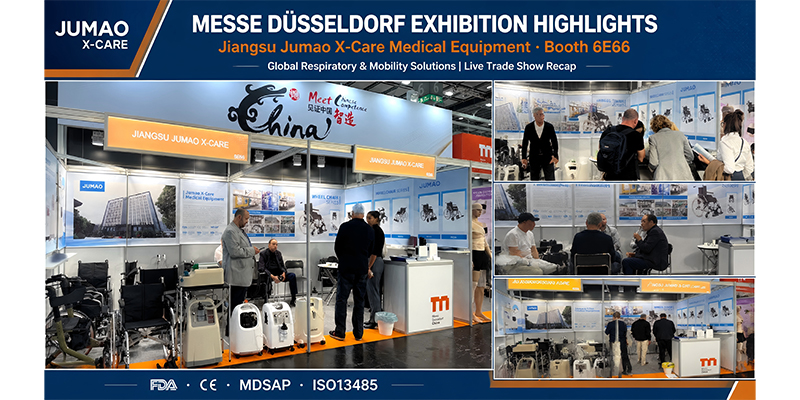
Düsseldorf, Germany — 29 September 2026 — Jiangsu Jumao X-Care Medical Equipment Co., Ltd (JUMAO) has concluded its participation in REHACARE 2026, the international trade fair for rehabilitation and care held at Messe Düsseldorf from 23 to 26 September 2026. At Booth 6E66, the company presented its rehabilitation and home care portfolio — manual and electric wheelchairs, rollators and walking aids, walking canes, adjustable nursing beds and portable oxygen concentrators — to distributors, care providers, therapists and retail partners from Europe and beyond. Visitors were able to handle and test products on the stand, and the team held one-to-one discussions on OEM and ODM projects and export requirements for European markets.
A demand curve, not a short-term trend
The context for this year’s show is well documented. WHO projects that by 2030, one in six people worldwide will be aged 60 years or over. The same organisation estimates that 2.5 billion people already need one or more assistive products, such as wheelchairs, and that this number will rise beyond 3.5 billion by 2050 — a trajectory driven by ageing populations and by the growing share of people living with long-term conditions.
Respiratory care follows the same line. In its COPD fact sheet updated in June 2026, WHO states that chronic obstructive pulmonary disease is the third leading cause of death worldwide, causing 3.4 million deaths in 2023 — roughly 6% of all global deaths — and notes that treatment includes medicines, oxygen and pulmonary rehabilitation. Oxygen therapy is no longer a hospital-only subject. For many patients it is a daily routine at home, and the equipment has to be designed for that reality.
From institutions to living rooms
Policy has moved in the same direction as the demographics. The UN Decade of Healthy Ageing (2021–2030), which WHO leads, sets out action areas including long-term care, integrated care and age-friendly environments; WHO’s Rehabilitation 2030 initiative works to strengthen rehabilitation services within health systems. The language of both is about functional ability and independent living, not only about treatment settings.
For manufacturers, that has practical consequences. Equipment that works in a ward — supervised, shared and frequently serviced — does not automatically work in a living room, where it may be operated by one person, often alone, every day. Portability, simple controls, quiet operation and stable quality become part of the product specification rather than a premium add-on.
What four days at the show made visible
Independent market research points to steady rather than spectacular growth: one estimate places the global walking assist devices market at USD 8.41 billion in 2026 and USD 11.23 billion by 2031, a compound annual growth rate of around 5.97% (Mordor Intelligence, July 2026). Growth of that order rewards manufacturers who can supply reliably over years, not those who chase a single season.
At Booth 6E66, the conversations followed that logic. Interest centred on how a whole care pathway fits together — moving, transferring, resting and breathing — rather than on individual products in isolation. Distributors and care providers asked how products behave in everyday use, how documentation is handled, and how consistent a second shipment will be compared with the first.
Where the hard work actually sits
Selling into Europe also means working inside its regulatory framework. Medical devices placed on the EU market are governed by Regulation (EU) 2017/745 (MDR), under which manufacturers must establish and maintain technical documentation covering design, testing and risk management, and keep it current. For buyers, the useful question is not only what a product does, but whether the manufacturer can produce and maintain the file behind it. That is JUMAO’s own reading of the market
— and it is why the company treats documentation as a product deliverable rather than as paperwork.
What JUMAO will do next
The company is building its next steps around five commitments:
• Keep the range integrated around the home care pathway — mobility, positioning and respiratory support — instead of selling isolated items.
• Prepare documentation to travel with the product: technical files, test reports and export paperwork ready for distributor due diligence.
• Protect batch-to-batch consistency, because a repeat order is the real quality test of a manufacturer.
• Feed field feedback — including from therapists and care providers met at shows — back into product development.
About Jiangsu Jumao X-Care Medical Equipment Co., Ltd
Jiangsu Jumao X-Care Medical Equipment Co., Ltd (JUMAO) is a manufacturer of rehabilitation and home care medical equipment, including oxygen concentrators, manual and electric wheelchairs, rollators and walking aids, walking canes, adjustable nursing beds and related care products. The company serves distributors, care institutions and retail partners worldwide with export-ready
solutions and flexible OEM/ODM support. For more information, visit www.jumaomedical.com.
Post time: Sep-28-2026