
Decide who moves the chair: the user or the caregiver
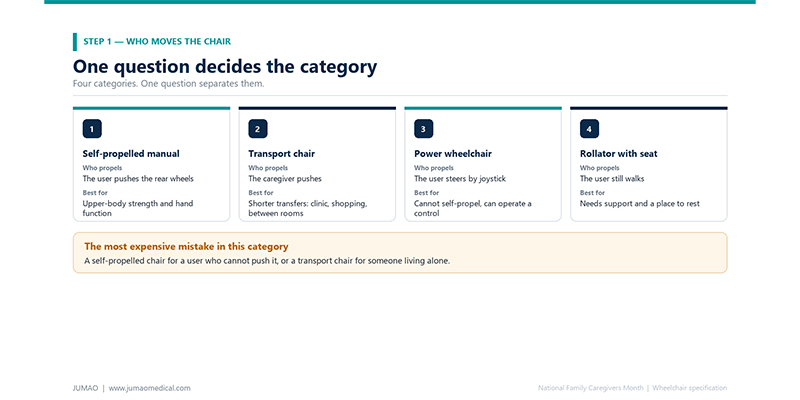
This single question determines the category:
- Self-propelled manual wheelchair — the user pushes the rear wheels. Best where the user has upper-body strength and hand function.
- Attendant-propelled / transport chair — the caregiver pushes. Transport chairs are typically lighter and designed for shorter transfers (clinic visits, shopping, moving between rooms).
- Power wheelchair — the user controls the chair via joystick; suited to users who cannot self-propel but can operate a control.
- Rollator / walker with seat — for users who still walk but need support and a place to rest.
Choosing a self-propelled chair for a user who cannot push it — or a transport chair for someone living alone — is the most common and most expensive mistake in this category.
Check weight capacity first, before anything else
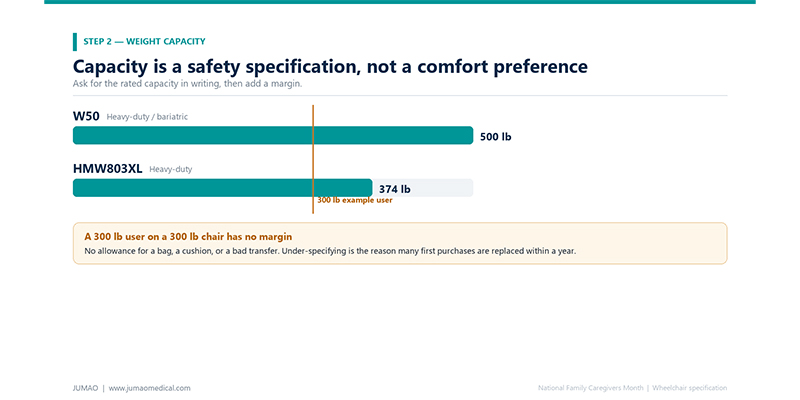
Weight capacity is a safety specification, not a comfort preference. Overloading a chair risks frame failure, and under-specifying it is the reason many first purchases are replaced within a year.
Our range spans economy to bariatric:
- Heavy-duty / bariatric — the W50 is rated up to 500 lb; the HMW803XL up to 374 lb.
- Standard and lightweight — models such as the W28, W98, W08, W71, W79A (standard) and the W807A, W51, W53A, W58, W58A, W59A, W68, W68F, HMW807, W24A (lightweight).
Ask for the rated capacity in writing, and add a margin: a 300 lb user on a 300 lb chair has no margin for a bag, a cushion, or a bad transfer.
Measure seat width and depth — do not estimate
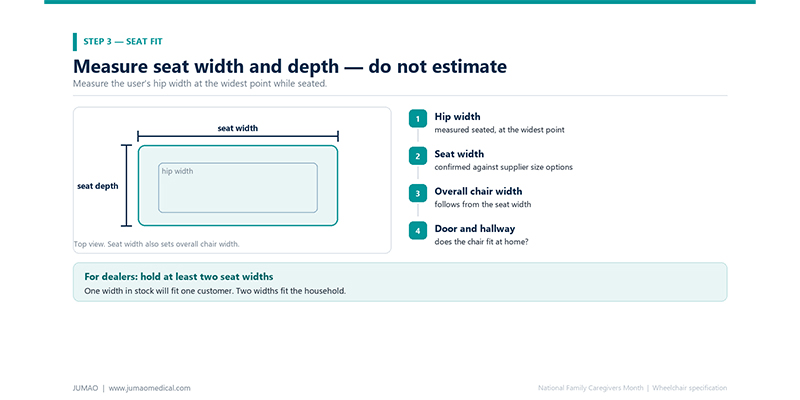
Seat fit drives comfort, posture and pressure distribution. Measure the user’s hip width at the widest point while seated, then confirm the available seat width options with the supplier before ordering. Note that seat width affects the overall chair width, which in turn decides whether the chair fits through the bathroom door or hallway at home.
Ask your supplier for their size options in writing — and if you are a dealer, keep at least two seat widths in stock rather than one.
Weigh the chair against the car boot
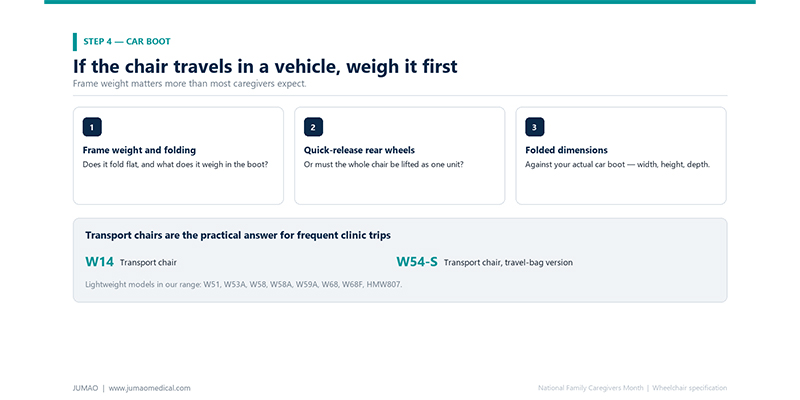
If the chair travels in a vehicle, the frame weight matters more than the user expects. Lightweight models in our range include the W51, W53A, W58, W58A, W59A, W68, W68F and HMW807. For caregiver-loaded chairs, check:
- Frame weight (and whether the chair folds flat)
- Whether the rear wheels are quick-release
- Folded dimensions against your actual car boot
Transport chairs are the practical answer for frequent clinic trips: the W14 and the W54-S travel-bag version are designed for exactly this pattern.
Confirm the details that fail first
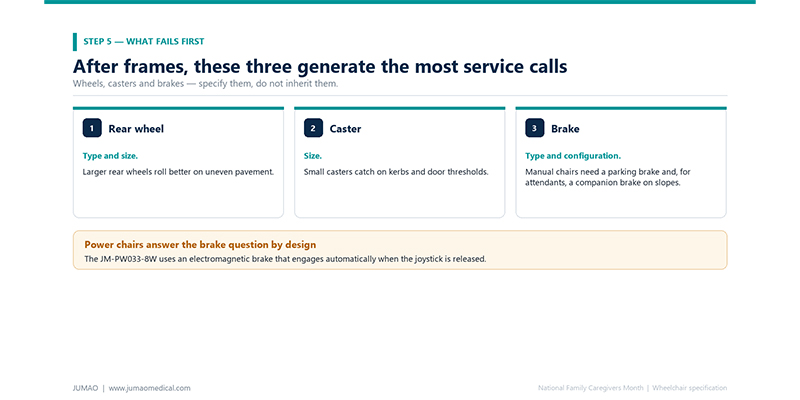
After frames, the components that generate the most service calls are wheels, casters and brakes. Specify:
- Rear wheel type and size — larger rear wheels roll better on uneven pavement.
- Caster size — small casters catch on kerbs and door thresholds.
- Brake type — manual wheelchairs need both a parking brake and, for attendants, a companion brake on slopes.
For power chairs, the brake question is answered by design: the JM-PW033-8W uses an electromagnetic brake, which engages automatically when the joystick is released.
Consider reclining and postural support
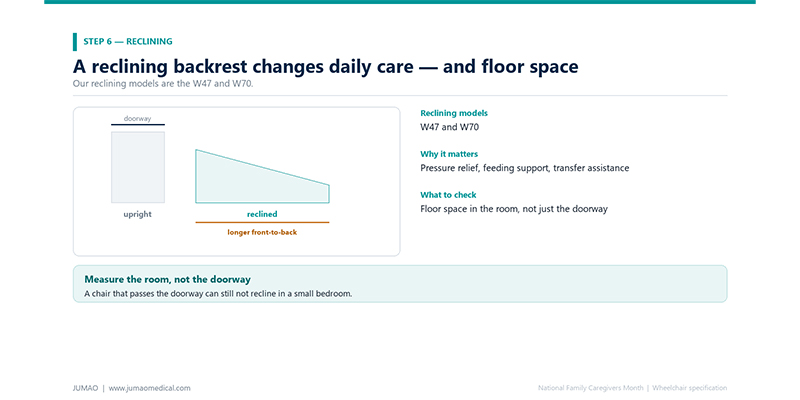
For users who need pressure relief, feeding support or transfer assistance, a reclining backrest changes daily care. Our reclining models are the W47 and W70. Reclining chairs are longer front-to-back when reclined — check the space in the room, not just the doorway.
Read power wheelchair specifications properly
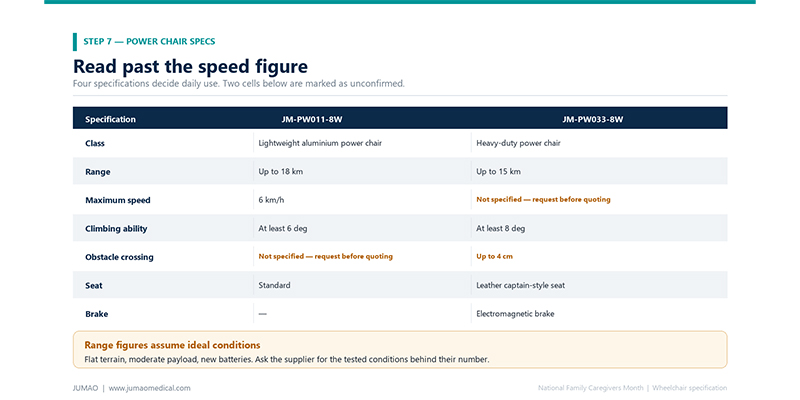
Power chair marketing often leads with speed. For actual daily use, the four specifications that matter are:
| Specification | JM-PW011-8W | JM-PW033-8W |
|---|---|---|
| Class | Lightweight aluminium power chair | Heavy-duty power chair |
| Range | Up to 18 km | Up to 15 km |
| Maximum speed | 6 km/h | 6 km/h |
| Climbing ability | At least 6° | At least 8° |
| Obstacle crossing | Not specified in our catalogue — request before quoting | Up to 4 cm |
| Seat | Standard | Leather captain-style seat |
| Brake | — | Electromagnetic brake |
Practical point:range figures assume ideal conditions— flat terrain, moderate payload, new batteries. If a user’s daily route includes hills or a heavy payload, plan for a shorter effective range and ask the supplier for the tested conditions behind their figure.
Multiply the specification by the forecast
A dealer’s decision is not “which chair is best” but “which range to hold”. Two numbers do most of the work:
Container loading (40ft HQ), from our catalogue:
| Model | Type | Cartons per 40ft HQ |
|---|---|---|
| W54-S | Transport chair (travel-bag version) | 840 |
| W14 | Transport chair | 592 |
| W51 | Lightweight | 400 |
| EC06 | Economy | 360 |
| JM-PW011-8W | Power wheelchair | 357 |
| W28 | Standard | 292 |
| W50 | Heavy-duty | 238 |
| W47 | Reclining | 213 |
| JM-PW033-8W | Power wheelchair | 192 |
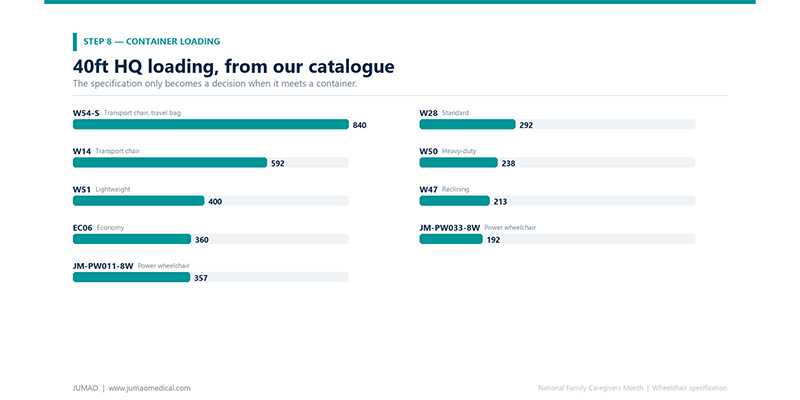
Container loading, from our catalogue.
Certification scope, by market:
- EU — Under Regulation (EU) 2017/745 (MDR), our power wheelchairs (JMPW series), manual wheelchairs (JMWC series) and lightweight rollators (JMLS series) are registered as Class I devices through our EU Authorized Representative Humiss Beratung GmbH ; see our Certificate of EU Medical Device Notification. Our power wheelchair series also holds an EU Declaration of Conformity.
- UK — Our manual wheelchairs are registered with the UK MHRA.
- Export documentation — Export sales certificates issued by the Jiangsu Medical Products Administration cover our electric wheelchairs and manual wheelchairs.
Approvals are per product family and per market. Confirm the certificate that names your model and destination before you quote a tender.
Ask about supply capacity, not just stock
For institutional and dealer orders, continuity matters as much as the first container. Our China facility has annual wheelchair capacity of 500,000 units, and our Thailand plant adds capacity for 600,000 wheelchairs per year. A plant that produces wheelchairs, transport chairs and mobility products for a specific export market — ours serves the US market from Cambodia — is usually a more stable second source than a single-line workshop.
Frequently asked questions
What is the difference between a wheelchair and a transport chair? A wheelchair is designed for the user to self-propel using the rear wheels. A transport chair is designed for an attendant to push, and is typically lighter — but not intended for independent use.
How do I choose between a manual and a power wheelchair? Start with upper-body strength and hand function. If the user cannot reliably self-propel and cannot operate a joystick either, the answer is usually an attendant-propelled chair.
What warranty applies? Warranty terms differ by model and market, and we do not state them in a blog post. Request the written warranty statement for the exact model in your quotation.
Can a wheelchair be used on an aircraft? That is always the airline’s decision, and requirements for battery-powered mobility devices vary by carrier and route. Confirm with the airline before travel.
Post time: Oct-29-2026